CJC-1295 in blood: albumin, pulses and proteins
Albumin helps one CJC-1295 form remain in circulation. Other blood proteins then move in different directions. The protein story gives the long hormone rise some company.
Albumin attachment
CJC-1295 begins with the active 1–29 portion of GHRH and changes four residues, at positions 2, 8, 15 and 27, to resist breakdown. Its long-acting form adds DAC, the Drug Affinity Complex, which binds covalently to albumin in blood. The original albumin-bioconjugate experiments describe that design.
Albumin is doing more than accompanying the drug in a sample. The chemical attachment helps prolong exposure. In rats, the design produced roughly four times the growth hormone exposure across two hours compared with unchanged hGRF(1–29), and albumin-bound peptide remained detectable beyond 72 hours.
The no-DAC form, also called Modified GRF (1–29), retains the four substitutions and lacks that attachment. Its half-life is roughly 30 minutes. I get frustrated by the missing suffix: the name CJC-1295 alone can hide a substantial difference in exposure. Human findings from the DAC form cannot establish the duration of the short-acting form.
Days after CJC-1295
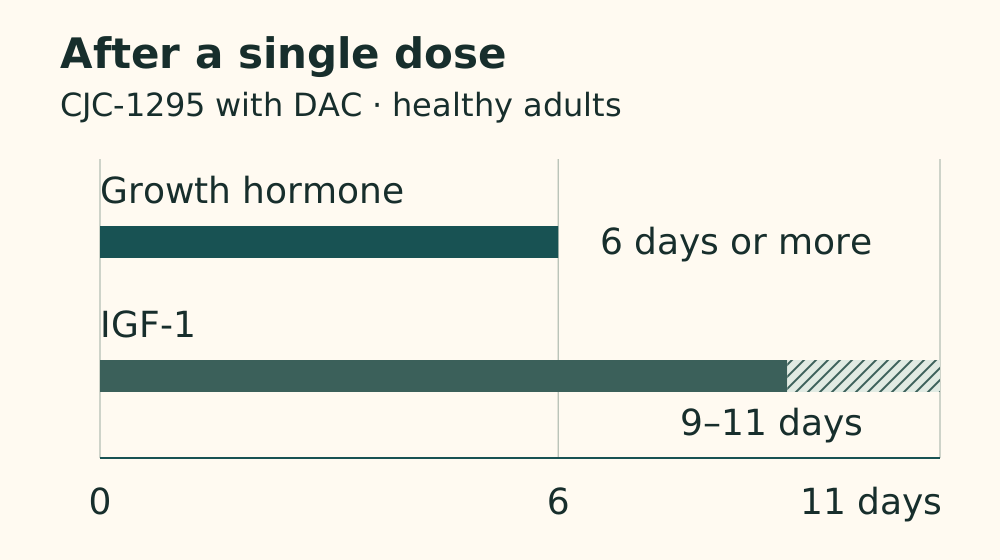
In healthy adults aged 21–61, CJC-1295 with DAC raised mean growth hormone 2- to 10-fold for six or more days. IGF-1 rose for 9–11 days; after repeated treatment it remained above baseline as late as 28 days. The measurements describe a sustained biological effect.
Another experiment followed healthy men aged 20–40. One week after a single injection, mean growth hormone was approximately 46% higher and IGF-1 approximately 45% higher. Pulse frequency and magnitude were unchanged; the level between pulses had risen.
That combination of findings has more texture than “keeps the natural rhythm.” The pulses continued against a higher background. I’d hesitate to call that an ordinary hormonal state simply because one feature remained familiar. Neither experiment established better sleep or stronger muscles.
Proteins moving in opposite directions
The serum-protein study in 11 healthy young men extended the picture. Apolipoprotein A1 and a transthyretin isoform decreased, while an albumin fragment and immunoglobulin/beta-hemoglobin species increased. An immunoglobulin/albumin-fragment signal correlated with IGF-1.
The researchers identified possible biomarkers of growth hormone and IGF-1 activity. A biomarker is a measurable biological clue. It can help describe a drug’s effects even when the experiment has supplied no patient benefit.
Among these CJC-1295 papers, the serum-protein result absorbs me most: the high hormone reading leaves a detectable wake elsewhere in blood. The changes deserve investigation on their own terms. They do not establish healthier immunity, improved circulation or an advantage for aging.
Development, safety and compounding
CJC-1295 reached a Phase 2 programme involving HIV-associated visceral obesity and was discontinued without approval. Public reports link a patient death with that development period; the public record did not establish CJC-1295 as the cause. That gap in the record is troubling. I’m unwilling to pronounce on causation from what is public.
Long-term human safety remains poorly characterized. Growth hormone can promote salt and water retention and reduce insulin sensitivity; prolonged IGF-1 exposure raises a theoretical concern about tumour growth. The GHRH review and secretagogue safety review provide class context. Those mechanisms leave the frequency of harms from CJC-1295 itself unresolved.
Anecdotal accounts describe deeper sleep, easier recovery and a leaner appearance, as well as puffiness, tingling, fatigue, headaches and local irritation. These are unverified personal reports rather than clinical evidence. Accounts that omit DAC status leave even the exposure unclear.
CJC-1295 has no approval from FDA or any major drug regulator. A 2024 advisory committee opposed its inclusion on the 503A compounding bulks list. On FDA’s page current as of April 22, 2026, its nomination appears in the withdrawn table, with no withdrawal date. Withdrawal grants no clearance. WADA prohibits CJC-1295 throughout the year.
An analytical paper identifying CJC-1295 in a seized preparation establishes that molecule’s identity in that sample. It cannot settle purity, sterility or clinical safety across other material. Pairing CJC-1295 with ipamorelin adds another uncharacterized exposure.